

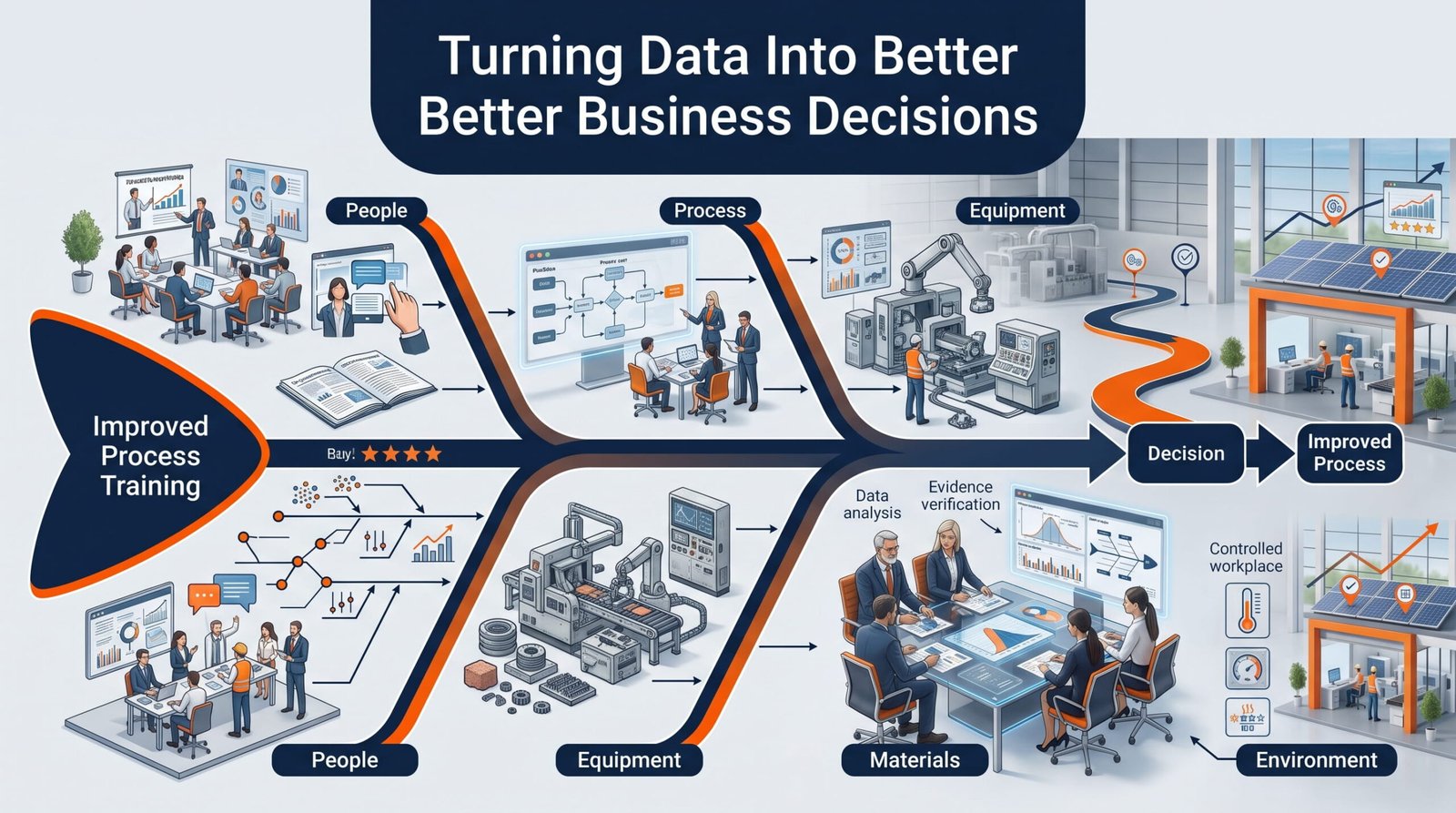
Business decisions often rely on experience, intuition, and historical performance. These factors matter, but they may not explain why a process performs inconsistently or where improvement will create the greatest value.
Six Sigma Black Belts take a different approach. They use data to understand process behavior, identify variation, validate root causes, and evaluate improvement opportunities.
Their role extends beyond solving individual quality problems. Black Belts help organizations make decisions based on measurable evidence rather than assumptions. This creates a more disciplined approach to improving quality, reducing defects, controlling costs, and strengthening operational performance.
Why Data Matters in Business Decisions
Organizations generate large amounts of operational data every day. Production records, customer complaints, cycle times, defect rates, service levels, and financial measures can reveal important patterns.
However, collecting data alone does not improve decision making. Teams must know which information matters and how to interpret it correctly.
Six Sigma Black Belts bring structure to this process by asking questions such as:
- What is the actual performance level?
- Where does process variation occur?
- Which factors influence the outcome?
- Is the suspected cause supported by evidence?
- Will the proposed improvement produce measurable results?
This approach helps organizations move from “We think this is the problem” to “The data shows where the problem exists and why.”
How Six Sigma Black Belts Use DMAIC
The DMAIC methodology gives Black Belts a structured framework for turning data into decisions. Each phase supports a different stage of the improvement process.
Define: Establish the Business Problem
Black Belts begin by defining the problem, project scope, customer requirements, and expected business outcomes.
A clearly defined problem prevents teams from spending resources on symptoms rather than meaningful business issues.
For example, instead of stating that customer service is performing poorly, a Black Belt may define a measurable increase in average response time or repeat service requests.
Measure: Establish the Current Reality
The Measure phase establishes reliable baseline performance.
Black Belts determine which metrics matter, evaluate measurement systems, and collect relevant process data. This creates an objective starting point for improvement.
Without accurate measurement, organizations may invest in solutions without knowing whether performance actually changed.
Analyze: Find the Factors Behind Performance
The Analyze phase connects data with potential causes.
Black Belts use tools such as Pareto analysis, process capability analysis, hypothesis testing, regression, and cause and effect analysis to examine relationships and variation.
This helps distinguish genuine drivers from assumptions.
A process may appear to have a staffing problem, for example, while the data reveals that scheduling patterns or process bottlenecks create most of the delays.
Improve: Turn Insights Into Action
Once the analysis identifies significant causes, Black Belts develop and test improvements.
They can compare potential solutions, assess their impact, and use data to determine which changes deliver meaningful results.
This reduces the risk of implementing expensive solutions that address the wrong problem.
Control: Make Better Performance Sustainable
Improvement does not end when a new solution works.
The Control phase establishes monitoring methods, process controls, documentation, and performance measures. These mechanisms help organizations detect unwanted variation before it becomes another major problem.
This creates a connection between data driven improvement and long term operational stability.
From Data Collection to Better Decisions
One of the greatest strengths of Six Sigma Black Belts is their ability to connect statistical analysis with business priorities.
Not every process variation deserves the same level of attention. Black Belts evaluate problems according to factors such as customer impact, financial consequences, process performance, risk, and improvement potential.
This allows organizations to prioritize projects more effectively.
For example, reducing a defect rate from 5% to 3% may appear positive. However, the business value depends on what those defects cost the organization. A Black Belt considers the financial and operational impact alongside the statistical improvement.
The result is a more complete decision making process.
Reducing Bias Through Statistical Thinking
Business decisions can become distorted by limited observations, personal opinions, or isolated incidents.
Statistical thinking provides a stronger alternative.
Six Sigma Black Belts examine patterns across relevant data rather than relying on individual examples. They can determine whether a change represents genuine improvement or normal process fluctuation.
This distinction is important because reacting to random variation can create unnecessary changes and introduce new problems.
Data therefore becomes more than a reporting mechanism. It becomes a tool for understanding how processes behave.
Supporting Continuous Improvement
The value of Six Sigma Black Belts extends beyond individual projects.
Their analytical approach can strengthen an organization’s broader improvement culture. Teams learn to define problems clearly, measure performance consistently, investigate causes systematically, and evaluate results objectively.
Over time, this encourages better questions and better decisions across departments.
Organizations can apply these principles to manufacturing, healthcare, logistics, financial services, technology, customer experience, and many other environments.
How TUVWESTEN Supports Six Sigma Black Belt Development
Developing effective Six Sigma Black Belts requires more than learning statistical tools. Professionals need to understand how to apply those tools within real business improvement projects.
TUVWESTEN supports Six Sigma Black Belt development by building advanced problem solving, analytical, and process improvement capabilities.
Through structured training, professionals can strengthen their understanding of DMAIC, statistical analysis, process performance, root cause analysis, and improvement project management.
This prepares participants to approach complex operational challenges with greater analytical discipline and make decisions supported by reliable evidence.
Better Data Leads to Better Decisions
Data does not automatically create better business decisions. The real advantage comes from knowing how to interpret data, challenge assumptions, identify meaningful variation, and connect findings with business objectives.
Six Sigma Black Belts provide that discipline.
By combining statistical thinking with structured improvement methodologies, they help organizations replace guesswork with evidence and isolated fixes with sustainable solutions.
When data becomes part of how an organization thinks and acts, improvement becomes more measurable, decisions become more defensible, and process performance becomes easier to manage.