

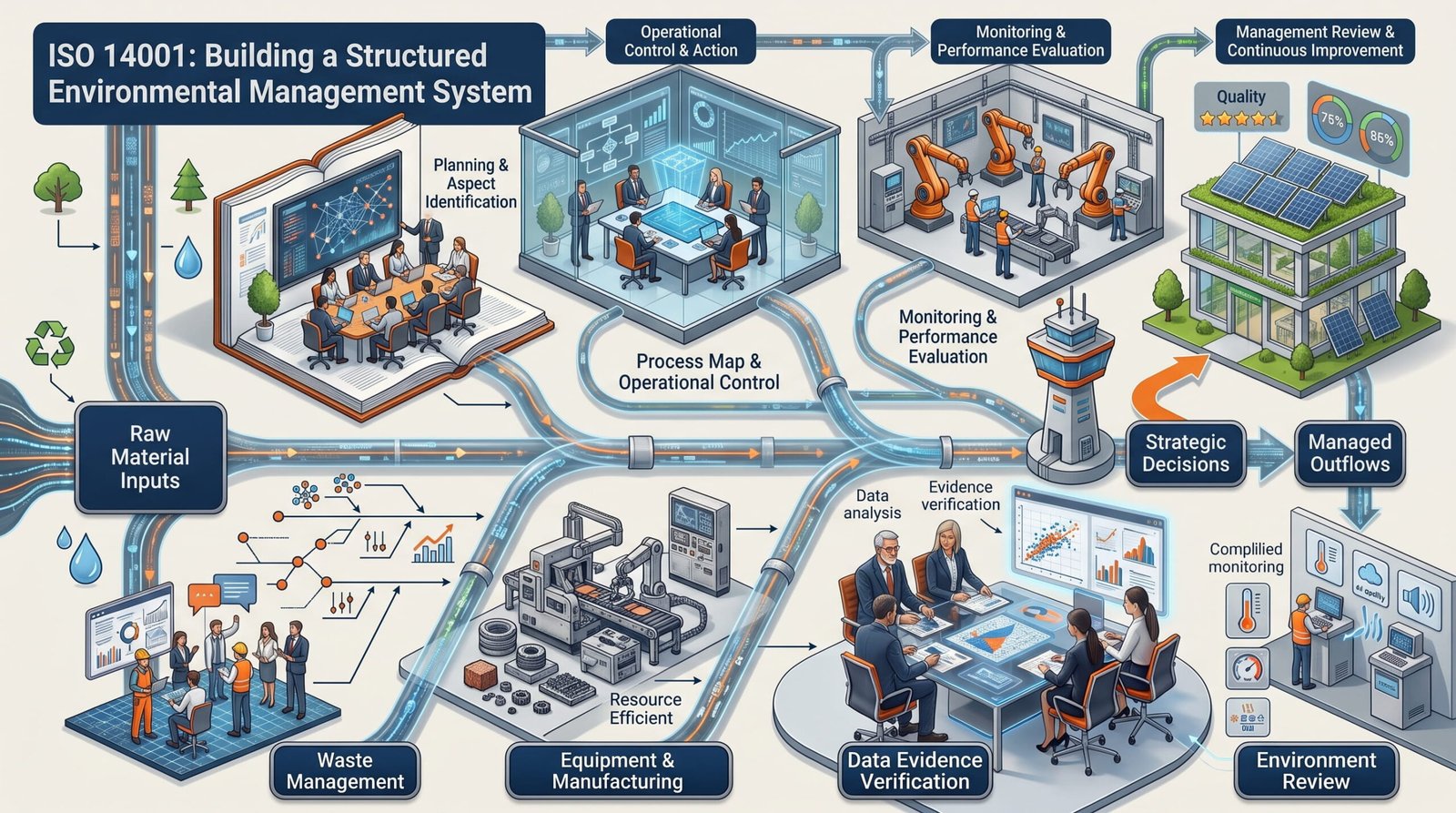
Environmental performance is becoming an increasingly important part of business management. Organizations must consider resource use, waste, emissions, pollution risks, regulatory obligations, and changing environmental conditions while maintaining operational efficiency.
However, environmental improvement requires more than isolated initiatives. Organizations need a systematic way to identify environmental impacts, establish objectives, monitor performance, and improve their processes.
This is where ISO 14001 provides value.
ISO 14001 specifies requirements for an Environmental Management System (EMS) that helps organizations manage environmental responsibilities systematically. The current ISO 14001:2026 edition is designed to help organizations enhance environmental performance, meet compliance obligations, and achieve environmental objectives.
What Is ISO 14001?
ISO 14001 is an international standard for Environmental Management Systems. It provides a framework that organizations can use to identify and manage environmental aspects associated with their activities, products, and services.
The standard does not prescribe one fixed environmental performance target for every organization. Instead, it allows organizations to develop an EMS based on their specific context, environmental aspects, compliance obligations, risks, and objectives.
This flexibility makes ISO 14001 applicable across different industries, organization sizes, and operational environments.
How ISO 14001 Supports Environmental Management
An effective Environmental Management System connects environmental responsibilities with everyday business processes.
Organizations can use ISO 14001 to address areas such as:
- Resource and energy efficiency
- Waste management
- Pollution prevention
- Environmental compliance
- Operational controls
- Emergency preparedness
- Environmental objectives and targets
- Monitoring and performance evaluation
- Continual improvement
Rather than treating environmental management as a separate activity, the standard encourages organizations to integrate it into business planning and decision-making.
The Role of Environmental Aspects and Impacts
One of the important foundations of ISO 14001 is understanding how organizational activities interact with the environment.
An organization needs to identify relevant environmental aspects associated with its activities, products, and services. It can then evaluate their potential environmental impacts and determine which aspects require greater control or attention.
For example, a manufacturing organization may examine energy consumption, wastewater, raw materials, emissions, packaging, and waste generated during production.
This analysis helps organizations move from general environmental intentions to specific areas where action can produce measurable improvement.
ISO 14001 and the PDCA Cycle
ISO 14001 uses the Plan-Do-Check-Act (PDCA) approach to support continual improvement.
Plan
Organizations establish their environmental policy, identify relevant environmental aspects, understand compliance obligations, assess risks and opportunities, and establish environmental objectives.
The planning stage creates direction and defines what the organization intends to achieve.
Do
The organization implements the processes needed to achieve its environmental objectives.
This can include operational controls, employee competence, communication, documented information, and emergency preparedness.
Check
Environmental performance must be monitored and evaluated.
Organizations can use measurements, internal audits, compliance evaluations, and other performance indicators to determine whether their EMS is working as intended.
Act
When performance gaps or nonconformities are identified, organizations take appropriate action and look for opportunities to improve.
This creates a continuous cycle rather than a one-time environmental initiative.
Business Benefits of ISO 14001
ISO 14001 can provide environmental and operational benefits when the system is properly implemented.
A structured EMS can help organizations improve environmental performance, strengthen compliance management, reduce waste, and improve resource efficiency. ISO also identifies potential benefits such as lower costs through more efficient use of energy, water, and resources, stronger stakeholder credibility, improved supplier performance, and access to markets where environmental credentials matter.
The U.S. Environmental Protection Agency similarly identifies potential benefits including improved environmental performance, pollution prevention, resource conservation, greater efficiency, reduced costs, and stronger environmental awareness among employees.
These benefits show why ISO 14001 should not be viewed only as a certification exercise. A well-designed EMS can become part of broader operational improvement.
ISO 14001 and Compliance Management
Environmental regulations and compliance obligations can vary significantly between industries and jurisdictions.
ISO 14001 provides a structured framework for identifying applicable obligations, integrating them into environmental planning, evaluating compliance, and taking action when gaps are identified.
This does not mean certification automatically guarantees compliance. Instead, the EMS creates processes that help organizations systematically manage their environmental responsibilities.
That distinction is important. Effective environmental management depends on how well the system operates in practice.
Continual Improvement Beyond Certification
Certification should not represent the endpoint of environmental management.
Organizations need to continue monitoring performance, reviewing objectives, responding to changing conditions, and improving controls.
The current ISO 14001 framework emphasizes continual improvement and allows environmental management to be integrated with other management systems. ISO notes that organizations can align their EMS with systems such as ISO 9001 and ISO 45001.
This integrated approach can reduce duplication and help organizations manage quality, safety, environmental, and other priorities through compatible management processes.
How TUVWESTEN Supports ISO 14001 Implementation
Implementing ISO 14001 effectively requires more than preparing documents for an audit. Organizations need to understand their environmental context, identify relevant aspects and impacts, establish appropriate controls, and develop processes that support continual improvement.
TUVWESTEN supports organizations in developing and strengthening their Environmental Management Systems through structured ISO 14001 consulting, training, and implementation support.
The focus is on helping organizations translate ISO 14001 requirements into practical processes that fit their operational context. This can include understanding environmental risks, establishing objectives, strengthening documentation, improving internal processes, and preparing the organization for effective system evaluation.
Building Environmental Performance Into Business Management
Environmental responsibility becomes more effective when it is managed as part of the organization rather than as a separate initiative.
ISO 14001 provides the structure to identify environmental impacts, manage obligations, establish measurable objectives, evaluate performance, and drive continual improvement.
The real value of an Environmental Management System comes from how consistently it is implemented and improved. When environmental considerations become part of operational planning and decision-making, organizations can strengthen environmental performance while also improving efficiency, resilience, and long-term business value.