

Introduction
Quality management is evolving faster than ever. Organizations are no longer judged solely on the quality of their products or services but on their ability to adapt, innovate, and consistently deliver value in a rapidly changing business environment. A Quality Management System (QMS) that worked five years ago may no longer be enough to support today’s operational challenges.
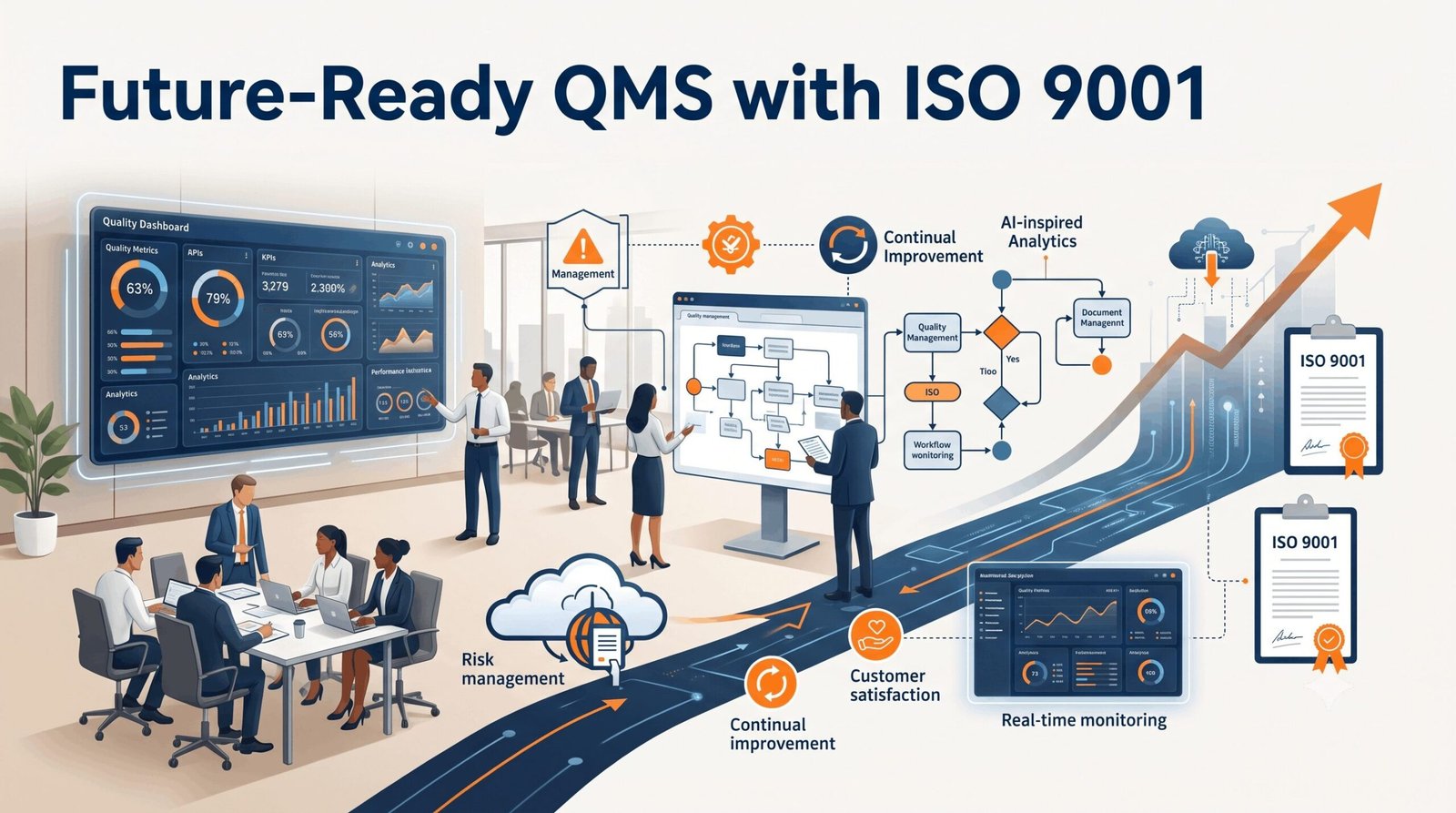
This is why preparing your QMS for the future has become a strategic priority. ISO 9001 provides a globally recognized framework that enables organizations to strengthen quality management while embracing digital transformation, improving decision-making, enhancing resilience, and driving continual improvement. Rather than treating quality as a compliance requirement, forward-thinking organizations use ISO 9001 to build systems that support sustainable growth and long-term business success.
Why Quality Management Is Changing
The expectations placed on organizations continue to evolve. Customers expect consistent quality, regulators demand greater accountability, and markets require businesses to respond quickly to changing conditions.
Traditional quality management systems often relied on manual documentation, periodic inspections, and reactive corrective actions. While these practices remain important, they are no longer sufficient on their own. Modern organizations need systems that provide real-time visibility, support informed decisions, and encourage continuous adaptation.
ISO 9001 has evolved alongside these changing business needs. Its process-based approach and emphasis on risk management, leadership, and continual improvement make it a flexible framework that supports organizations in both stable and rapidly changing environments.
Digital Quality Is Transforming the Modern QMS
Digital transformation is reshaping how organizations manage quality. Manual processes are gradually being replaced by digital tools that improve efficiency, accuracy, and collaboration.
A digital QMS enables organizations to manage documents, monitor quality objectives, track nonconformities, and analyze performance through centralized systems. Employees can access the latest procedures instantly, while management gains greater visibility into operational performance.
Benefits of adopting digital quality practices include:
- Faster document control and approval processes
- Improved traceability across operations
- Reduced administrative workload
- Better collaboration between departments
- More accurate quality records
- Faster response to quality issues
ISO 9001 supports digital transformation by encouraging organizations to establish controlled, measurable, and continually improving processes that can be enhanced through modern technology.
Data Driven Decisions Strengthen Business Performance
Successful organizations make decisions based on evidence rather than assumptions. ISO 9001 promotes this principle by encouraging organizations to monitor, measure, analyze, and evaluate process performance.
Using accurate data helps organizations:
- Identify trends before they become major issues
- Monitor process effectiveness
- Measure customer satisfaction
- Evaluate quality objectives
- Improve resource allocation
- Support strategic planning
Instead of reacting after problems occur, data-driven organizations can anticipate challenges and implement preventive actions. This proactive approach improves consistency, reduces waste, and supports better business outcomes.
When quality metrics become part of everyday decision-making, the QMS evolves from an operational tool into a strategic asset.
Building Business Resilience Through ISO 9001
Today’s organizations operate in an environment of constant change. Supply chain disruptions, evolving customer expectations, regulatory updates, and technological advancements require businesses to remain flexible and prepared.
ISO 9001 helps organizations build resilience by encouraging risk-based thinking and proactive planning. Rather than waiting for problems to occur, organizations identify potential risks, evaluate their impact, and implement controls that reduce uncertainty.
A resilient QMS supports:
- Consistent operational performance
- Faster response to disruptions
- Better resource management
- Stronger leadership involvement
- Improved business continuity
- Greater organizational confidence
Organizations with resilient quality systems are better equipped to adapt to change while maintaining the consistency their customers expect.
Customer Focus Remains the Driving Force
While technology and business practices continue to evolve, customer focus remains the foundation of ISO 9001.
An effective QMS is designed to consistently meet customer requirements while identifying opportunities to enhance satisfaction. Organizations that actively gather customer feedback, monitor service quality, and improve processes are more likely to build lasting relationships and strengthen their reputation.
Customer-focused organizations benefit from:
- Higher customer satisfaction
- Increased customer loyalty
- Fewer complaints
- Improved product and service quality
- Stronger market competitiveness
Preparing a QMS for the future means ensuring that every improvement ultimately contributes to delivering greater value for customers.
Continual Improvement Creates Long-Term Success
The most successful organizations never view quality as a finished project. They continuously evaluate performance, identify opportunities for improvement, and refine their processes.
ISO 9001 embeds continual improvement throughout the Quality Management System. Through internal audits, management reviews, corrective actions, and performance monitoring, organizations create a culture where improvement becomes part of everyday operations.
Continual improvement helps organizations:
- Eliminate recurring problems
- Improve operational efficiency
- Reduce process variation
- Increase employee engagement
- Strengthen quality performance
- Adapt to changing business needs
This ongoing commitment to improvement enables organizations to remain competitive in an increasingly dynamic marketplace.
Preparing Your QMS for Tomorrow
Future-ready organizations recognize that quality management is no longer limited to maintaining compliance. A modern QMS must support innovation, resilience, operational excellence, and strategic decision-making.
Preparing your QMS for the future involves more than updating procedures. It requires integrating digital technologies, using performance data effectively, strengthening leadership involvement, managing risks proactively, and creating a culture of continual improvement.
Organizations that regularly evaluate and enhance their Quality Management Systems are better positioned to respond to change, improve efficiency, and achieve sustainable growth.
How TUVWESTEN Supports Future Ready Quality Management
Building a future-ready Quality Management System requires practical expertise and a structured implementation approach. TUVWESTEN supports organizations through every stage of their ISO 9001 journey, including gap analysis, system design, documentation, employee training, internal audits, and certification readiness.
By combining international best practices with industry experience, TUVWESTEN helps organizations develop Quality Management Systems that go beyond compliance. The focus is on creating practical, efficient, and scalable systems that strengthen operational performance, support continual improvement, and deliver measurable business value.
Conclusion
The future of quality management belongs to organizations that are prepared to evolve. Digital transformation, data-driven decision-making, business resilience, customer focus, and continual improvement are no longer optional. They are essential elements of a modern Quality Management System.
ISO 9001 provides the framework to help organizations build these capabilities while maintaining consistency, improving efficiency, and delivering lasting value. By preparing your QMS for the future today, your organization will be better equipped to navigate change, exceed customer expectations, and achieve sustainable success.
With expert guidance from TUVWESTEN, organizations can confidently modernize their Quality Management Systems, strengthen operational excellence, and build a foundation for long-term growth in an increasingly competitive business environment.