

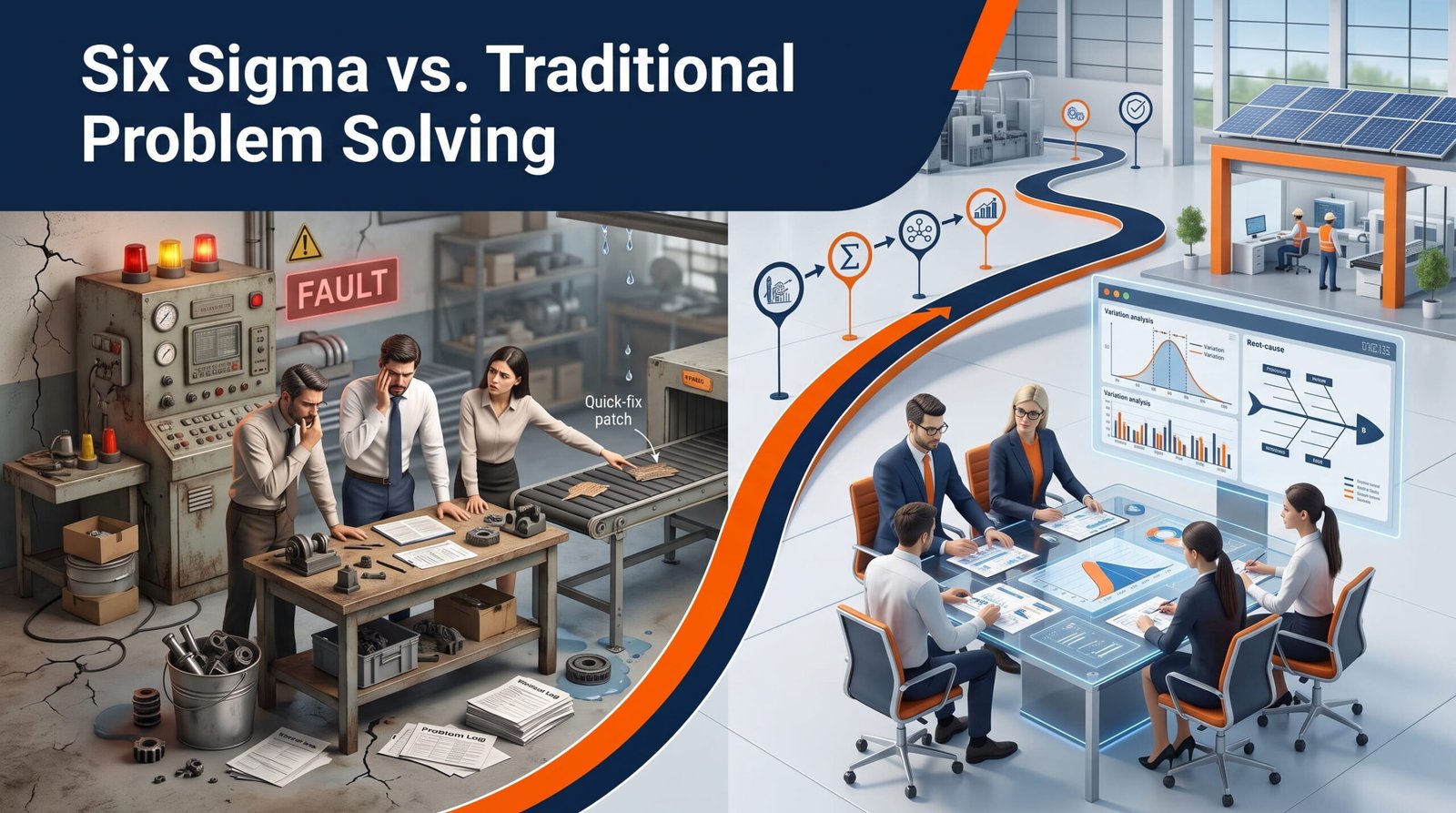
Every organization faces problems. Delays, defects, customer complaints, process variation, waste, and recurring errors can affect performance at any level. The real challenge is not always identifying a problem. It is determining whether the solution will actually prevent it from returning.
Traditional problem solving often focuses on fixing the immediate issue. This approach can work well when a problem has an obvious cause and a straightforward solution. However, complex or recurring problems require deeper analysis.
This is where Six Sigma creates a significant difference. Six Sigma provides a structured, data-driven approach to identifying causes, reducing variation, improving processes, and sustaining results.
Understanding the difference between Six Sigma and traditional problem solving can help organizations choose the right approach for the right challenge.
What Is Traditional Problem Solving?
Traditional problem solving typically begins when an issue becomes visible. Teams investigate what happened, identify a likely cause, and implement a corrective action.
For simple problems, this approach can be efficient. An equipment issue may require a replacement part. A documentation error may require a correction. A communication gap may require clarification.
The challenge appears when organizations apply the same approach to complex or recurring problems.
Common characteristics of traditional problem solving include:
- Focus on the immediate issue
- Reliance on experience and assumptions
- Limited data analysis
- Quick corrective actions
- Focus on visible symptoms
- Less emphasis on process variation
These methods are not inherently ineffective. However, they can become limited when the real cause is hidden within a complex process.
A problem may disappear temporarily while the conditions that created it remain unchanged.
What Makes Six Sigma Different?
Six Sigma approaches problems from a process and data perspective. Instead of asking only what went wrong, it asks why the process allowed the problem to occur and how performance can improve permanently.
The methodology focuses heavily on reducing variation and defects. It helps organizations understand how processes perform, identify factors affecting outcomes, and implement solutions based on evidence.
Six Sigma is particularly valuable when organizations face:
- Recurring quality problems
- High process variation
- Significant operational waste
- Customer dissatisfaction
- High defect rates
- Costly process failures
- Complex operational challenges
The objective is not simply to fix a problem. It is to improve the process that produced the problem.
DMAIC Brings Structure to Problem Solving
One of the biggest differences between traditional problem solving and Six Sigma is the use of the DMAIC framework.
DMAIC stands for Define, Measure, Analyze, Improve, and Control.
Define
The first stage establishes a clear problem statement, project objective, scope, and customer requirements.
A vague problem creates vague solutions. Defining the problem precisely ensures that improvement efforts address the right issue.
Measure
The Measure phase establishes a factual understanding of current performance.
Teams collect relevant data and establish a baseline. This prevents organizations from relying solely on assumptions or opinions.
Analyze
During the Analyze phase, teams investigate the causes behind the problem.
They examine process data, identify patterns, evaluate relationships, and use tools such as Root Cause Analysis, process mapping, and statistical analysis.
The goal is to distinguish actual causes from symptoms.
Improve
Once the causes are understood, teams develop and test solutions.
The Improve phase focuses on eliminating or reducing the factors responsible for poor performance. Solutions should be evaluated using measurable evidence rather than assumptions.
Control
The final stage ensures that improvements remain effective.
Teams establish controls, monitoring methods, documentation, and performance measures. This helps prevent the process from returning to its previous condition.
Together, these five stages create a disciplined improvement cycle.
Data Changes the Quality of Decisions
Traditional problem solving may depend heavily on experience. Six Sigma adds another dimension: evidence.
Data helps organizations understand how a process actually performs rather than how employees believe it performs.
For example, a team may believe that production delays come from staffing shortages. Process data may reveal that most delays actually occur during equipment changeovers.
Without measurement, the organization could invest resources in the wrong solution.
Data-driven problem solving reduces this risk. It allows teams to identify patterns, quantify performance, test assumptions, and evaluate whether improvements produce measurable results.
This makes Six Sigma particularly valuable for decisions involving significant operational costs or complex processes.
Six Sigma Focuses on Process Variation
A major strength of Six Sigma is its focus on variation.
Two products may follow the same process but produce different outcomes. Two shifts may use the same procedure but achieve different performance levels. A service process may meet customer expectations one day and fail the next.
These inconsistencies often indicate process variation.
Six Sigma helps organizations understand why variation occurs and how it affects quality, cost, productivity, and customer satisfaction.
Reducing unnecessary variation creates more predictable processes and more consistent results.
When Should Organizations Use Six Sigma?
Six Sigma is not the answer to every business problem.
Organizations should consider the methodology when problems are complex, recurring, costly, or difficult to understand. It is especially useful when teams need reliable data to determine what is actually causing poor performance.
A simple problem may only require a straightforward corrective action. A recurring process failure may require deeper analysis.
The key is choosing the right level of problem solving for the situation.
Six Sigma becomes particularly powerful when organizations need to move from reactive correction to structured improvement.
From Problem Solving to Continuous Improvement
The long-term value of Six Sigma extends beyond individual projects.
When organizations apply structured improvement methods consistently, employees begin to approach problems differently. Teams become more comfortable using data, measuring performance, questioning assumptions, and looking for underlying causes.
This supports a culture of continuous improvement.
Organizations can achieve benefits such as:
- Lower operational costs
- Reduced defects
- Improved process consistency
- Less waste
- Better customer satisfaction
- More reliable decision-making
- Sustainable performance improvements
The focus gradually shifts from asking, “How do we fix this?” to asking, “How do we improve the process so this does not keep happening?”
How TUVWESTEN Supports Six Sigma Capability
Developing effective Six Sigma capability requires structured training and practical understanding. TUVWESTEN helps professionals and organizations build the knowledge required to apply Six Sigma methodologies to real operational challenges.
Through Six Sigma training and professional development, TUVWESTEN supports participants in understanding structured problem-solving, data-driven analysis, process improvement, and the DMAIC methodology.
This helps organizations develop professionals who can move beyond quick fixes and contribute to measurable, sustainable improvement.
Traditional problem solving has its place. Straightforward problems often need straightforward solutions. However, recurring and complex problems require a more disciplined approach.
Six Sigma provides that structure by combining data, process analysis, root cause investigation, statistical thinking, and the DMAIC framework. Instead of simply addressing visible symptoms, it helps organizations understand why problems occur and how processes can perform better.
The real difference is not simply the number of tools used. It is the mindset behind the improvement process.
Traditional problem solving asks how to fix the problem. Six Sigma asks how to improve the process that created it.
For organizations seeking stronger quality, greater efficiency, and sustainable performance, that difference can have a measurable impact. With the right expertise and training from TUVWESTEN, teams can develop the capability to turn complex problems into structured opportunities for improvement.